ABC Dumplings Journal
Starch Science for Gluten-Free Dumpling Wrappers: Rice, Potato and Tapioca Explained
An educational guide to the agricultural starches that help gluten-free dumpling wrappers hold, steam, crisp and taste balanced.
This guide is part of the ABC Dumplings journal. You can also bok choy, tofu and mushroom dumplings or gluten-free dumpling wrapper guide while reading.
Why wrapper science matters
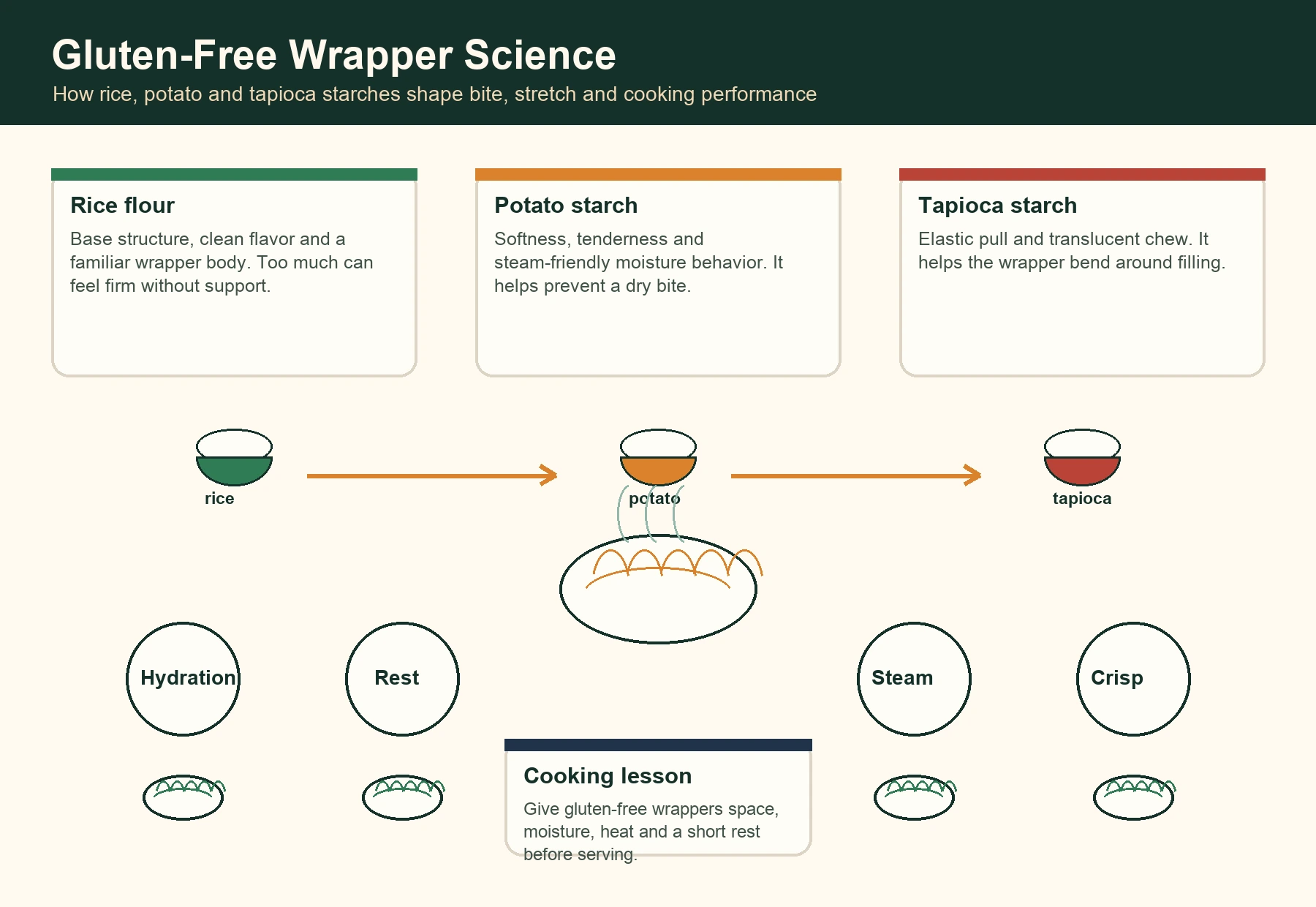
A dumpling wrapper is the first texture a eater meets and the last structure holding the filling together. In wheat-based dumplings, gluten can provide elasticity and strength. In a gluten-free dumpling, the wrapper has to earn those qualities through a different system. Rice flour, potato starch, tapioca starch, water, oil, salt, turmeric and structure-building ingredients each contribute something. The goal is not to imitate wheat perfectly. The goal is to create a wrapper that folds cleanly, freezes well, heats through from frozen and still feels tender at the table. That is a real food-science challenge, and it is one reason gluten-free dumplings should be judged by cooking performance rather than by label language alone.
Rice flour gives body
Rice flour is often the backbone of gluten-free wrappers because it brings a familiar grain flavor and a stable base. It can help a dumpling feel like food rather than gel. But rice flour alone can be firm, brittle or dry when the dough is pushed too far. A wrapper needs enough body to carry filling, but not so much that the bite becomes chalky. This is where crop processing matters. Fine milling, hydration and the relationship with other starches all shape the final texture. For shoppers, the important lesson is that rice flour is not just a replacement word for wheat. It is one structural member in a larger wrapper design.
Potato starch supports softness
Potato starch can make a wrapper feel softer and more steam-friendly. It interacts with moisture differently from rice flour, which can help the wrapper avoid a hard or sandy bite. In a frozen dumpling, that softness is useful because the wrapper moves through a harsh cycle: freezing, storage, direct heat and cooling on the plate. If the wrapper dries out, the first bite feels like compromise. If it gets too soft, the dumpling can tear. Potato starch helps create a middle path when the rest of the formula is balanced. The best result is not mushy. It is tender enough to let the filling stay juicy.
Practical note
For best results, cook only the amount you plan to eat, give each dumpling space and serve while the wrapper is hot. Small technique choices have a larger effect with gluten-free wrappers because the starch blend keeps changing as it cools.
Tapioca starch adds elastic chew
Tapioca starch, derived from cassava, is valued in many gluten-free foods because it can contribute stretch, chew and a slight translucence. In dumplings, that can help the wrapper bend around filling and survive the movement from tray to steamer or pan. Too much elasticity can feel gummy, so tapioca has to be controlled. The ideal wrapper does not bounce like candy and does not collapse like paste. It gives a clean pull, then yields to the filling. This is why ingredient lists need context. The presence of tapioca starch is not automatically good or bad. Its value depends on proportion, hydration and cooking instructions.
Hydration decides whether starches behave
Starches do not perform well just because they are present. They need the right hydration and heat. A dough can feel smooth at mixing time but still cook poorly if water is not distributed well. Frozen dumplings add another layer because ice crystals and storage time can change how the wrapper behaves. That is why a gluten-free wrapper should be tested in the same way it will be used: from frozen, with steam, in a pan and on a real plate. A recipe that works fresh may not work frozen. A wrapper that looks neat raw may not hold a simmer. Wrapper science is practical, not theoretical.
Practical note
For best results, cook only the amount you plan to eat, give each dumpling space and serve while the wrapper is hot. Small technique choices have a larger effect with gluten-free wrappers because the starch blend keeps changing as it cools.
Freezing is a wrapper stress test
The freezer is where weak wrapper design becomes visible. Moisture can migrate. Edges can dry. Pieces can stick if they thaw and refreeze. The USDA FSIS freezing guidance is helpful because it separates safety from quality: freezing can keep food safe when held properly, but texture and flavor still depend on handling. For a gluten-free dumpling, that means the brand has to design for the freezer rather than treating freezing as an afterthought. The wrapper should release from the tray, survive packaging movement and cook from frozen without requiring a complicated thawing ritual. Convenience only works when the material science supports it.
A practical wrapper checklist
Use this checklist when judging gluten-free dumplings at home or for a retail freezer set.
- The wrapper should not crack visibly before cooking.
- The pleats should stay sealed through steam or pan-fry steps.
- The bite should be tender, not pasty or chalky.
- The bottom should crisp when the pan method is followed correctly.
- The wrapper should not overpower the filling with starch flavor.
- The dumpling should remain enjoyable for several minutes after serving.
Cooking method changes the eating experience
The same dumpling can tell a different story depending on how it is cooked. Steaming emphasizes tenderness and filling aroma. Pan-frying adds contrast: soft top, crisp bottom and a little browning. Boiling can feel comforting when the filling is chicken or pork and the dumplings are handled gently. Gluten-free wrappers can perform well across methods, but the cook has to respect spacing and moisture. Crowding is the enemy. A crowded pan lowers temperature, traps steam where crisping is supposed to happen and increases sticking. A crowded steamer can make wrappers merge. Good method protects good starch work.
Why the vegetarian dumpling is a useful test
The bok choy, tofu and mushroom dumplings are a useful test case because the filling is vegetable-forward and moisture-sensitive. A weak wrapper cannot hide behind a heavy meat filling or a thick sauce. It has to hold greens, tofu and mushrooms while letting the savory notes remain clear. If the wrapper feels too heavy, the vegetarian filling can seem muted. If the wrapper is too fragile, the moisture can expose every weakness. This is why vegetarian dumplings are often a strong way to evaluate whether a gluten-free wrapper has been thoughtfully built.
Clean label does not mean starch-free
Some shoppers see starches and assume they are filler. That can be true in careless food design, but it is not automatically true in gluten-free dumplings. Starch is the architecture of the wrapper. The clean-label question is whether the starch system is understandable and useful. Rice, potato and tapioca have clear jobs. The same principle applies to avocado oil, salt, turmeric or konjac when they support dough behavior, color, mouthfeel or structure. A wrapper can be clean and still be engineered. The best food design is often simple to explain but careful in execution.
How to serve wrappers at their best
Serve gluten-free dumplings promptly. As starch-based wrappers cool, texture changes. A dumpling that is tender and glossy at the table can feel firmer if it sits under a tight lid. Use a wide plate, not a deep bowl, when you want crisp bottoms to stay crisp. If you are cooking multiple batches, hold them loosely covered and refresh briefly in the pan rather than steaming them until they sweat. Sauce should be close, but not poured over everything too early. These details sound small, yet they respect the work built into the wrapper.
Test the wrapper across real cooking methods
A wrapper formula should be tested against the ways people actually cook. Steam checks tenderness and seal strength. Pan-frying checks whether the base can brown and release from the skillet. Boiling checks whether the edges can survive movement in water. Home cooks rarely behave like laboratory technicians, so the wrapper needs some forgiveness. It should not require perfect timing, a special pan or a thawing ritual. This is why the gluten-free dumpling wrapper guide matters: it turns starch science into repeatable kitchen behavior.
Storage tells the truth about starch design
A fresh test is not enough for a frozen dumpling brand. The wrapper also needs to be checked after realistic storage, transport and temperature changes. It should not develop excessive cracking, freezer burn flavor or sticky surfaces when handled correctly. Starch systems can be sensitive to moisture migration, so the dumpling has to be evaluated as a whole product: wrapper, filling, tray contact, bag environment and cooking directions. A beautiful raw dumpling is only half a success. The real success is a dumpling that still cooks well after waiting in the freezer for a busy weeknight.
Do not overclaim what gluten-free means
Gluten-free is valuable for people who avoid gluten, but it should not be presented as a universal health shortcut. A gluten-free wrapper can still be thoughtful, satisfying and cleaner than many freezer options, but the claim has a specific meaning. Good education keeps that meaning precise. It explains the wrapper ingredients, reminds shoppers to check current packaging and avoids suggesting that gluten-free automatically solves every dietary concern. That honesty builds trust. It also keeps attention on what the product can truly deliver: a dumpling wrapper designed without wheat that still tastes good when cooked from frozen.
The takeaway
Gluten-free wrapper science is not a niche technical detail. It is the reason a frozen dumpling can feel satisfying instead of compromised. Rice flour, potato starch and tapioca starch each carry agricultural and functional meaning. Together, they create a wrapper that has to hold filling, freeze, cook, flex and taste good. A shopper does not need to memorize starch chemistry to make a good choice. They only need to ask whether the wrapper performs: does it stay sealed, cook from frozen, feel tender and let the filling shine? When the answer is yes, the wrapper has done its quiet work.